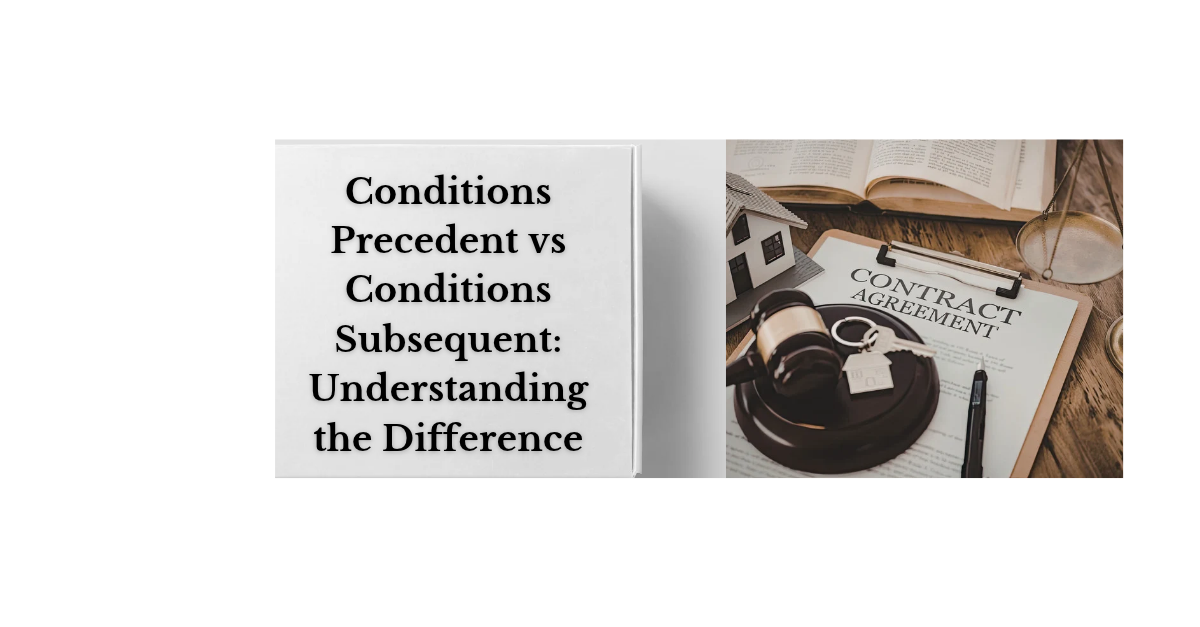
Almost every commercial agreement — from a share purchase deal to a simple service contract — contains conditions that must be satisfied before or after obligations take effect. Two of the most frequently confused categories are conditions precedent and conditions subsequent. They sound similar, appear in similar clauses, and are often drafted carelessly as if they were the same thing. They are not. The distinction determines when an obligation arises, when it can be terminated, and who bears the risk if a required event never happens.
What Is a Condition Precedent?
A condition precedent is an event or act that must occur before a contractual obligation becomes enforceable — or, in some cases, before the contract itself comes into existence. Until the condition is satisfied, the obligation it qualifies simply does not arise.
Under Indian law, this concept is closely tied to Section 31 of the Indian Contract Act, 1872, which deals with “contingent contracts” — contracts to do or not do something if some event, collateral to the contract, does or does not happen. Section 32 goes further: where a contract is contingent on the happening of a future uncertain event, it cannot be enforced until that event happens; if the event becomes impossible, the contract becomes void.
In transactional practice, conditions precedent (often shortened to “CPs”) are the standard gatekeeping mechanism between signing and closing. In an Indian M&A or investment deal, typical CPs include:
- Regulatory approvals (competition clearance, sectoral approvals under FEMA)
- Amendment of the Articles of Association to reflect shareholder rights
- Resignation or appointment of specified directors
- Assignment of intellectual property to the company
- No material adverse change in the target’s business between signing and closing
- Delivery of a closing certificate confirming satisfaction of the above
Only once these are satisfied — or expressly waived by the party they were meant to protect — does the obligation to close and fund the transaction become enforceable. A condition precedent that is never satisfied does not put a party in breach; it simply means the obligation dependent on it never came into existence, and either party may typically terminate the agreement (often after a “long-stop date”).
What Is a Condition Subsequent?
A condition subsequent operates in the opposite direction. It is an event that, if it occurs after an obligation has already arisen or a contract has already come into force, brings that obligation (or the contract itself) to an end. The obligation exists and is binding from the outset — the condition subsequent is what terminates it.
This is also addressed within the broader contingent contract framework of the Indian Contract Act. Section 32 deals with contracts contingent on an event happening; where a contract is contingent on an event not happening — the mirror-image scenario, which is closer to how conditions subsequent typically function — Section 33 applies, and the contract can be enforced when the happening of that event becomes impossible.
In practice, conditions subsequent commonly appear as:
- Post-closing covenants that, if breached, trigger termination or a buy-back right
- Employment agreements that automatically terminate on the occurrence of a specified event (e.g., loss of a required license or regulatory disqualification)
- Licensing or franchise agreements that terminate automatically if a party loses a specific certification or regulatory registration
- Loan agreements where a specified event of default automatically accelerates repayment obligations
Unlike a condition precedent, a condition subsequent does not prevent the obligation from arising — the parties are already bound, already performing, and already relying on the contract. The condition subsequent is a built-in exit or termination trigger layered onto an otherwise live agreement.
The Core Distinction, Simplified
| Feature | Condition Precedent | Condition Subsequent |
|---|---|---|
| Timing | Before the obligation arises | After the obligation has already arisen |
| Effect | Obligation does not come into existence until satisfied | Existing obligation is terminated or discharged |
| Typical use | Deal gating (M&A, investment closings) | Ongoing contract termination triggers |
| Statutory anchor (India) | Sections 31–32, Indian Contract Act, 1872 | Section 33 and general contingent contract principles |
| Failure consequence | No breach — the dependent obligation simply never arises | The contract or obligation ends; may or may not constitute a breach depending on drafting |
Why the Distinction Matters in Drafting
1. It determines when a party is actually bound. Misclassifying a condition precedent as if it were automatically satisfied (or vice versa) can create real disputes over whether an obligation to perform — or to pay — ever actually arose.
2. It affects available remedies. Failure of a condition precedent generally does not, by itself, give rise to a damages claim — the contract simply never became enforceable on that point. Failure to comply with a condition subsequent, by contrast, may trigger termination rights and, depending on the clause, damages for the period the contract was live.
3. It shapes negotiation leverage. In deal contexts, whoever’s benefit a condition precedent is drafted for typically holds the power to waive it. Careless drafting that fails to specify “for the benefit of [Party]” can leave both parties uncertain whether a CP can be unilaterally waived at all.
4. It affects long-stop and termination mechanics. Contracts should specify what happens if a condition precedent is not satisfied by a long-stop date — automatic termination, an extension right, or a renegotiation trigger. Contracts should equally specify whether a condition subsequent terminates the agreement automatically or merely gives the innocent party an option to terminate.
Common Drafting Mistakes
- Failing to specify a long-stop date for conditions precedent, leaving a deal in limbo indefinitely if a CP is never satisfied.
- Not stating whose benefit a CP is for, creating ambiguity over waiver rights.
- Drafting conditions subsequent without specifying automatic termination vs. optional termination, which changes whether continued performance after the triggering event constitutes a fresh waiver.
- Confusing a condition precedent with a mere covenant — a covenant is a promise to act; a condition precedent is a gating event, and conflating the two can misstate what actually needs to happen before performance is due.
The Bottom Line
Conditions precedent and conditions subsequent both control when contractual obligations take effect or end — but they operate in opposite directions. A condition precedent is a gate that must be opened before an obligation exists; a condition subsequent is a trigger that closes a door on an obligation that already exists. Understanding which category a given clause falls into — and drafting it precisely as such — is essential to knowing exactly when a party is bound, when it can walk away, and what remedy is available if something goes wrong.
This article is for general informational purposes only and does not constitute legal advice. Consult a qualified lawyer for guidance on a specific contract or transaction.




Leave a Reply